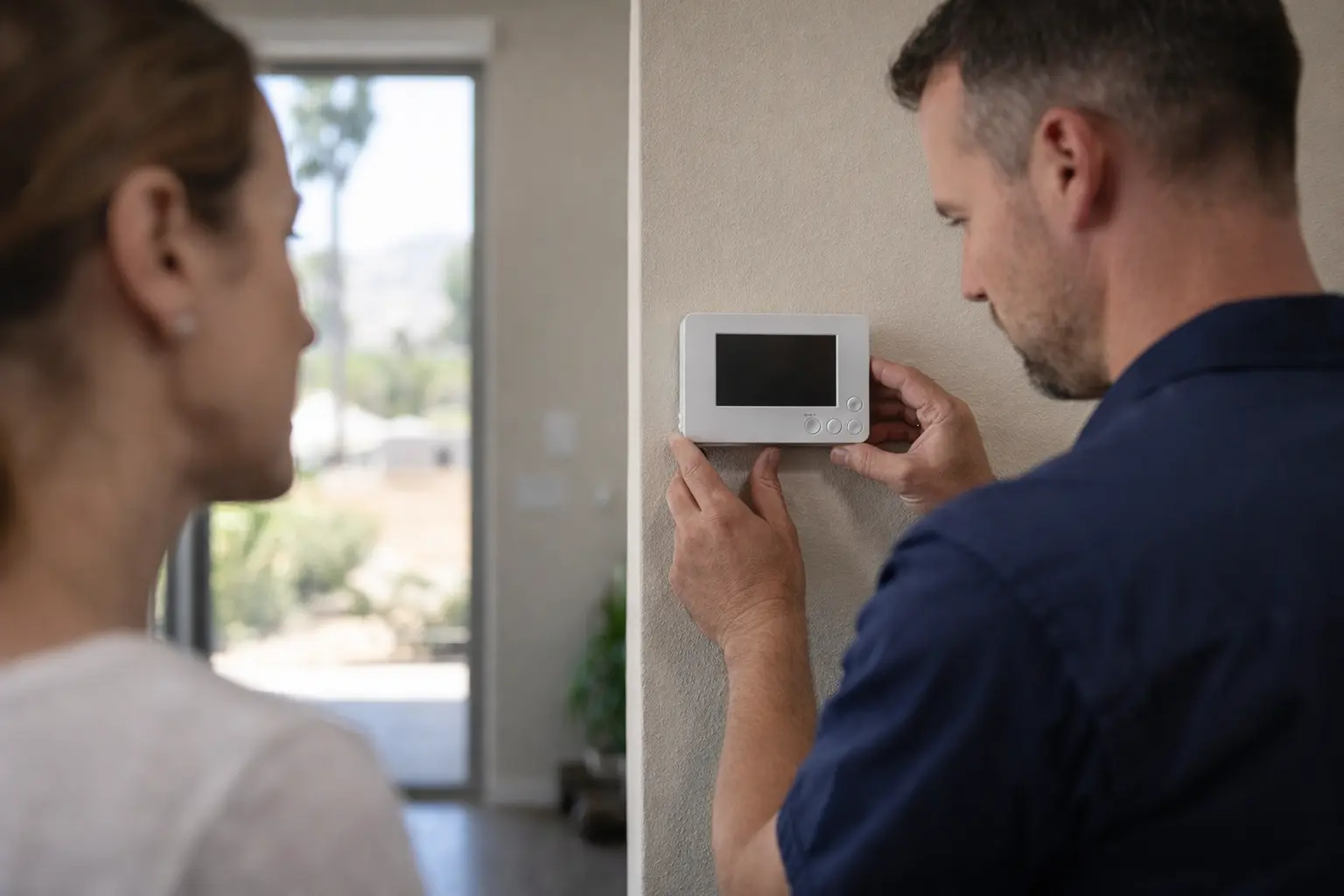
If your thermostat screen is blank and your HVAC system will not start, you are likely dealing with a 24V control power issue. In Hemet homes, this usually happens after power flickers, clogged condensate drains, blown low-voltage fuses, or a furnace switch accidentally turned off.
Many homeowners search for no power to thermostat, ” ” AC no power to thermostat, or furnace no power to thermostat because the symptoms feel identical: a dead thermostat, no heating or cooling. The good news is that several causes are safe to check if you follow the right order.
Safety First: Stop Troubleshooting If You Notice Any of These
- Burning smell, smoke, buzzing, or melted wiring
- Water is pooling around electrical compartments
- Visible scorching near wires or control boards
- You are not comfortable opening equipment panels safely
If any of these are present, stop and call a licensed HVAC technician.
What No Power to Thermostat Usually Looks Like
Most homeowners describe one of these situations:
- Thermostat completely blank (no lights, no display, no response)
- Thermostat turns on briefly, then reboots or dies
- Display works intermittently, but the system will not run reliably
If the display is fully blank, the thermostat is often not receiving low-voltage control power from the indoor unit.
60-Second Check: Blank Screen vs System Not Running
If the thermostat screen is blank
This is usually a power path problem:
- Blown 3A/5A low-voltage fuse
- Tripped condensate float safety switch
- Furnace or air-handler service switch turned off
- Door safety switch not engaged
- Transformer or wiring fault
If the screen is on, but the HVAC does not run
That is often a different issue (lockout, failed component, communication error). This guide focuses on the true blank-screen power-loss scenario.
Step-by-Step Hemet Checklist to Restore Thermostat Power
Follow these in order to avoid guesswork.
1) Check batteries first (if your model uses them)
Some thermostats, especially certain Honeywell models, can go blank from weak batteries. Replace batteries and test again before opening any equipment panel.
2) Check breakers and the indoor equipment switch
Check HVAC breakers in the main panel, then check the furnace/air handler switch near the unit (often looks like a regular light switch).
Important: thermostat power usually comes from the indoor unit, not the outdoor condenser.
3) Confirm the furnace/air-handler panel is fully seated
Most indoor units have a door safety switch. If the panel is slightly misaligned after a filter change, power to the controls can be cut off, and the thermostat may appear dead.
If your heating side is also affected, check furnace repair in Hemet, CA
4) Check the drain and float switch (very common in the Hemet cooling season)
This is very common during the Hemet cooling season. Long AC run times can clog condensate drains and trip the safety float switch, which may interrupt thermostat control power.
Look for:
-
Water in or near the drain pan
-
Float switch near the condensate line
-
Recent humidity or prolonged cooling cycles
If airflow is weak or moisture issues keep returning, review the air duct cleaning service in Hemet, CA.
If water has already spread into walls or flooring, start with water damage restoration in Hemet, CA
5) Inspect the low-voltage fuse on the control board (3A/5A)
If power is present but the thermostat is still dead, check for a blown low-voltage fuse. This is one of the most common causes of no power to the thermostat when the breaker is not tripped.
Common triggers:
- Shorted thermostat wire
- Miswiring after thermostat replacement
- Pinched wire behind the thermostat plate
If a new fuse blows again quickly, stop and schedule a professional diagnosis.
6) If still blank, suspect transformer/wiring/control board
If all checks above pass and there is still no display, likely causes are:
- Failed 24V transformer
- Damaged control board
- Open/short in thermostat wiring
- Loose low-voltage terminal connection
This stage requires testing tools and should be handled by a technician.
No Power to Thermostat Breaker Not Tripped: Why It Happens
This is the most confusing scenario for homeowners.
The breaker protects high-voltage power (120/240V), while thermostat controls run on low-voltage (typically 24V). So the unit can still have line power while the thermostat loses control power due to a fuse, safety switch, transformer, or wiring issue.
If It Started After a Thermostat Change or a Power Outage
After replacing the thermostat
A dead screen after installation often points to:
- Miswired terminals
- Pinched wire behind the wall plate
- Missing/loose common wire in smart thermostat setup
- Blown low-voltage fuse from a wiring short
After a power outage or flicker
Surges can damage or stress:
- Low-voltage fuse
- Transformer
- Control electronics
If power events happened recently, check the fuse and the control power path first.
Smart Thermostat Notes: Nest, Honeywell, Ecobee
Google Nest
Most Nest setups rely on a stable 24V system power. If Nest is blank, do not assume device failure first. Check the indoor unit switch, float switch, fuse, and transformer path before replacing hardware.
Honeywell
Some Honeywell models are battery-heavy, while others rely more on HVAC 24V. Start with batteries, then follow standard control power checks if the screen stays blank.
Ecobee
Ecobee systems typically need a reliable 24V and the correct common-wire configuration. Frequent no-power calls are often caused by system-side control interruptions, not the thermostat itself.
Thermostat Wiring Basics Homeowners Can Check Safely
You can safely:
- Remove the thermostat faceplate and reseat it
- Look for visibly loose, damaged, or pinched wires
- Confirm terminals look intact and dry
Basic terminal reference:
- R = power
- C = common
- W = heat call
- Y = cooling call
- G = fan
If unsure, avoid trial-and-error rewiring. Random wire changes can blow fuses or damage the board.
When to Call a Local Hemet HVAC Pro
Call a pro if:
- Fuse keeps blowing
- The float switch keeps tripping
- You smell burning or hear buzzing at the controls
- The thermostat keeps dying after outages
- You suspect transformer/control board failure
For Hemet homeowners, this issue is often a combination of drain safety events and low-voltage faults. A proper diagnosis prevents repeat failures and unnecessary part swapping.
If you want fast, accurate troubleshooting, Rain or Shine Heating, Plumbing & Air Conditioning can identify whether the root cause is fuse, drain safety, wiring, transformer, or control board and fix it correctly.
FAQs
How do I reset a blank thermostat?
If your thermostat uses batteries, replace them first. For smart models, remove from base for about 30 seconds, then reseat. If it remains blank, the issue is usually not reset-related. It is typically a control power problem from the HVAC system.
Why is my thermostat blank, but the breaker is not tripped?
This is common. Breakers protect high-voltage power, but thermostat controls use low-voltage power. A blown fuse, tripped float switch, open door switch, wiring fault, or failed transformer can kill thermostat power even when breakers appear normal.
How do I know if my thermostat is bad or if it’s not getting power?
A bad thermostat is less common than a loss of control power. If batteries do not help and the screen stays blank, inspect the indoor unit switch, panel seating, float switch conditions, and low-voltage fuse. If these pass, test the transformer/wiring professionally.
Can a clogged drain shut off the thermostat’s power?
Yes, in many systems. A blocked condensate line can trip a float safety switch, which may interrupt the control circuit and leave the thermostat blank. This is a frequent issue during heavy cooling months in warm areas like Hemet.
What should I check before calling HVAC service?
Check batteries, breaker, indoor unit power switch, panel door alignment, and obvious drain overflow signs. If the control board fuse is accessible and blown, replace it once only. If it blows again or the thermostat stays dead, call for a diagnosis.
How much does thermostat replacement cost?
Cost depends on thermostat type and wiring requirements. In many cases, the thermostat is not the main issue. The larger cost driver is diagnosing and correcting the underlying power fault, such as a blown fuse, wiring short, float switch event, or transformer failure.
Is there no power to the thermostat in an emergency?
It can become urgent during extreme heat or cold, especially for young children, older adults, or medical needs. While some causes are minor, unresolved control power faults can hide deeper electrical or drainage issues. If symptoms persist, schedule service promptly.
Does Rain or Shine handle thermostat power issues in Hemet?
Yes. Rain or Shine troubleshoots blank thermostat and no-power control circuit problems across Hemet and nearby areas. The team diagnoses root cause first, explains options clearly, and fixes the issue safely without unnecessary parts or guesswork.
Final Word for Hemet Homeowners
If your thermostat is blank, do not keep swapping parts blindly. Most no power to thermostat issues trace to the 24V path: fuse, float switch, wiring, or transformer, especially when the breaker is not tripped.
For a safe, accurate fix, contact Rain or Shine Heating, Plumbing & Air Conditioning and get a proper diagnosis from a local Hemet HVAC team.
Written by the Rain or Shine Comfort Team
Licensed, local professionals serving Hemet, CA, and nearby areas of Riverside County with HVAC, plumbing, water softener installation, and water damage restoration services. We focus on clear diagnostics, honest options, and dependable workmanship so homeowners can make confident decisions.